Lightning: The Clipper
Lightning: The Clipper That Met Its End at Geelong
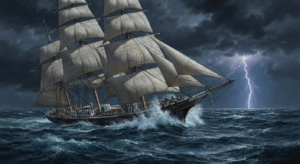
Lightning survived years of ocean passages before fire destroyed her within sight of Geelong’s waterfront. The wooden clipper, built in America for Britain’s Australian trade, became famous for speed and carried thousands of passengers to Victoria. Her final struggle took place in the sheltered waters of Corio Bay.
For readers of MV Wyuna, Lightning opens another chapter in Victoria’s maritime heritage. You can follow her story from Donald McKay’s shipyard to the gold-rush passenger trade, then examine the records behind her dramatic loss. Those records preserve both remarkable achievements and questions that remain unanswered.
Key Takeaways: Lightning: The Clipper
- Donald McKay built Lightning at East Boston for James Baines’s Black Ball Line, launching the wooden clipper in January 1854.
- Lightning earned a reputation for extraordinary sailing performance, including a reported run of 436 nautical miles within twenty-four hours.
- The ship carried passengers to Victoria and return cargoes to Britain, linking her history with migration and colonial trade.
- Fire destroyed Lightning at Geelong on 31 October 1869; the subsequent inquiry found no evidence establishing how it started.
- MV Wyuna’s preservation project protects a different chapter of Victorian maritime life, connecting readers with the importance of safeguarding working vessels.
Built for the Australian Gold Rush
Donald McKay built Lightning for the passenger trade created by Australia’s gold rush. James Baines & Co., owners of Liverpool’s Black Ball Line, commissioned the three-masted ship from McKay’s East Boston yard. She was launched on 3 January 1854.
The design combined a sharply hollowed bow with a fuller middle body and substantial sail-carrying ability. According to Museums Victoria, the aim was a fast vessel that retained stability and could carry sail effectively.
Lightning belonged to a competitive shipping world in which a fast passage helped attract passengers and cargo. The later Schomberg, another Black Ball Line clipper, emerged from the same ambition to serve the Australian trade.
What Made Lightning: The Clipper Famous for Speed?
Lightning became famous for long daily runs and rapid ocean passages. Museums Victoria records a claimed run of 436 nautical miles in twenty-four hours, an achievement that helped establish the ship’s reputation among the celebrated clippers of her era.
Passage times require care. Museums Victoria gives a Melbourne-to-Liverpool return of 63 days, while Heritage Victoria describes a 64-day passage under Captain James Nicol Forbes. These summaries do not establish whether they use identical departure and arrival points or counting conventions.
You can recognise Lightning’s remarkable performance without turning a disputed figure into an absolute record. The dependable point is her reputation for speed, rather than a claim that every published passage time agrees.
Passengers, Cargo and New Lives in Victoria
Lightning linked Victoria with Britain by carrying passengers outward and valuable cargoes home. Museums Victoria credits her with sixteen voyages from England to Victoria between 1854 and 1869, carrying approximately 5,597 passengers. Return cargoes included gold and wool.
Those figures place the ship within a larger story of migration and trade. A passage brought people, skills and possessions into a growing colony; a homeward cargo connected Victorian production with overseas markets. Passenger ships were part of the infrastructure through which colonial society expanded.
MV Wyuna’s history helps you explore a later chapter of immigration by sea. The pilot vessel carried the mariners who boarded arriving ships, rather than transporting gold-rush passengers herself.
The Fire at Geelong on 31 October 1869
Fire destroyed Lightning at Geelong on 31 October 1869 while she was loading wool. The alarm came at about one in the morning. Water was pumped into the lower hold, but the efforts of the local volunteer fire brigades could not save the vessel.
The tug Resolute towed the burning clipper away from Yarra Street Wharf. The response shifted from extinguishing the fire to trying to sink the ship. Boring holes and cutting planking proved unsuccessful, and volunteer artillery also attempted to send her down.
The Victorian Heritage Database records that Lightning finally sank at about six that evening. Explosives were subsequently used to remove the wreck. The register identifies the loss as a major calamity in Geelong’s shipping history.
What Did the Fire Inquiry Find?
The inquiry found that Lightning was destroyed by fire, but it could not establish how the fire began. Crucially, the jury concluded that spontaneous combustion was not the cause. Presenting damp wool as the proven explanation would contradict that finding.
Public Record Office Victoria preserves the original fire-inquest records, including witness depositions and the official verdict. Its account places the inquiry at Mack’s Hotel, Geelong, on 3 November 1869.
The jury also found that the captain and officers had done all in their power to save the ship. You can distinguish that recorded conclusion from the speculation surrounding the blaze. An unexplained cause does not justify inventing a culprit, motive or sequence of events.
Lightning and the Maritime Landscape of Port Phillip
Lightning’s career belongs to the history of ships negotiating Port Phillip’s entrance and trading ports. Her speed across an ocean did not remove the importance of local navigation, coastal knowledge and careful handling near land.
The history of the Port Phillip pilots explains the specialist service that developed around those demands. MV Wyuna later supported that work by accommodating pilots offshore and enabling their transfer to merchant vessels.
The bay also preserves other kinds of maritime evidence. HMVS Cerberus represents colonial naval defence rather than the passenger trade. Reading these histories together reveals distinct working roles within the same maritime landscape.
How Do Records and Models Preserve Lightning’s Story?
Archives, objects and ship models preserve Lightning’s story after the loss of the vessel herself. Public Record Office Victoria’s account identifies a photograph of the burning ship and a surviving piece of timber in the Flagstaff Hill Maritime Village collection.
Museums Victoria documents a detailed model made by Michael Molesworth with rigging and fittings by Alan Tyler. Such work helps you understand the arrangement of a sailing ship that photographs of a distant hull cannot fully explain.
Other wreck histories show why research must remain open to new evidence. The account of TSS Coramba follows a much later vessel whose resting place was confirmed only after decades of uncertainty.
Keeping Victoria’s Maritime Heritage Within Reach
Lightning’s legacy survives through evidence that people have chosen to preserve. Her construction, passenger voyages and final fire connect shipbuilding with migration, trade and the work of a Victorian port.
MV Wyuna’s preservation project gives you a way to support a surviving vessel from a different era. The project protects a pilotage and training legacy, with restoration and future public interpretation as its goals. It does not establish an operational connection between Wyuna and Lightning.
If this history interests you, the guide to supporting MV Wyuna explains ways to contribute. Protecting a working vessel and preserving an archive serve related purposes: keeping the evidence available for future generations.
FAQs About the Lightning Clipper Ship
Who Built the Lightning Clipper Ship?
Donald McKay built Lightning at East Boston, Massachusetts, for James Baines & Co.’s Black Ball Line. Launched on 3 January 1854, she was commissioned for the Australian passenger trade during the gold rush and became celebrated for her sailing performance.
What Was Lightning’s Famous Daily Sailing Run?
Museums Victoria records a claimed run of 436 nautical miles in twenty-four hours. That figure belongs to Lightning’s historical reputation for speed. Published summaries differ on some passage times, so claims of an unbeaten record should identify their source and measurement.
Why Did Lightning Catch Fire?
The cause of Lightning’s fire was not established by the inquiry. The jury specifically rejected spontaneous combustion and found no evidence showing how the blaze began. The ship was destroyed at Geelong on 31 October 1869 while loading wool.
Did Lightning and MV Wyuna Serve Together?
No. Lightning was lost in 1869, long before MV Wyuna’s launch in 1953. Their connection is the broader maritime history of Victorian waters. MV Wyuna’s preservation helps you explore the later pilotage and training chapters of that history.