
Hmas Huon
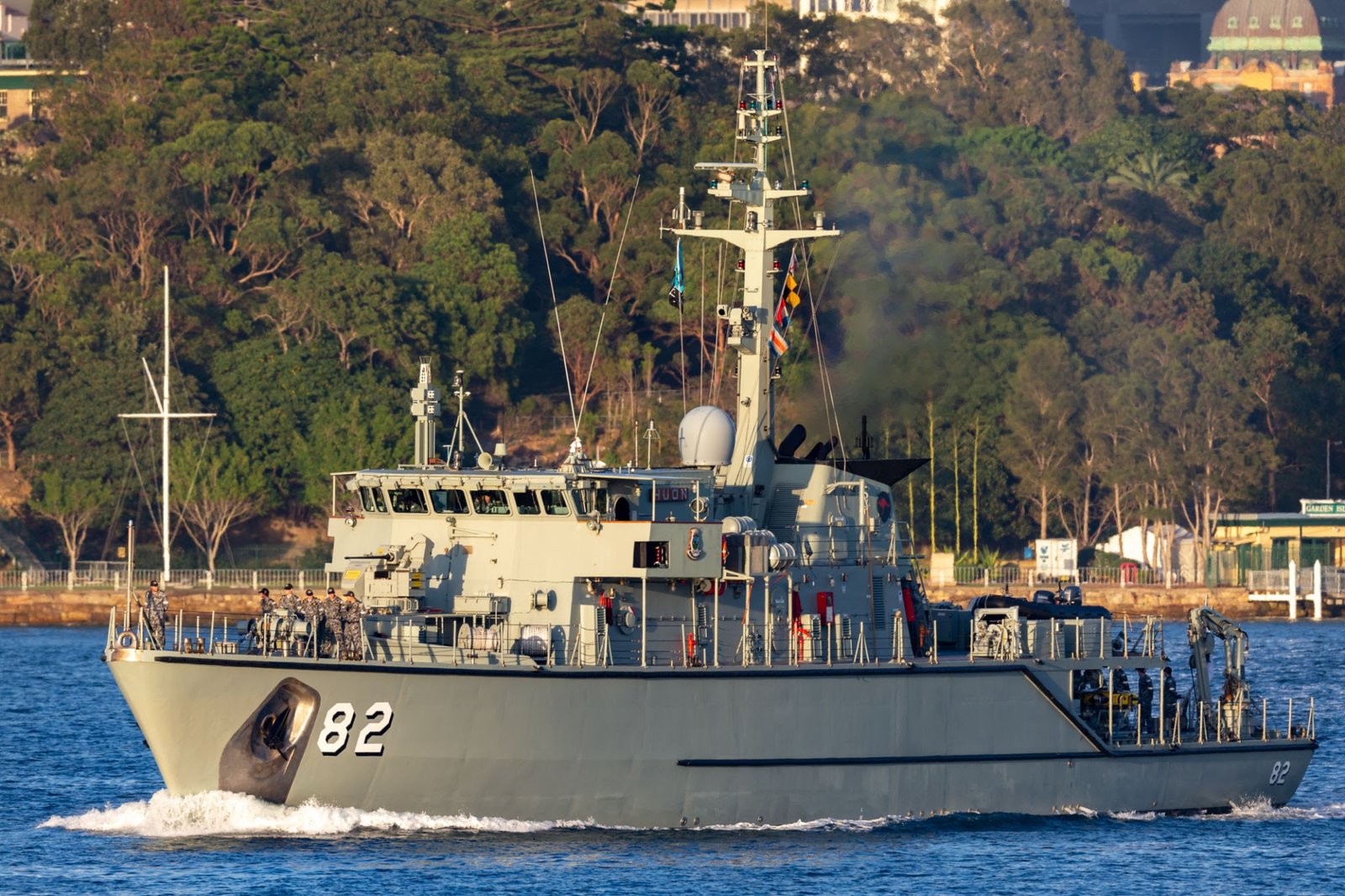
HMAS Huon refers to two notable vessels in Royal Australian Navy (RAN) history, both of which take their name from Tasmania’s Huon River. Today, the name most commonly refers to HMAS Huon (M 82), which serves as the lead ship of Australia’s Huon-class minehunters.
HMAS Huon (M 82) — Minehunter Coastal (1999–Present) The RAN officially commissioned HMAS Huon (M 82) on May 15, 1999, to lead a fleet of six Huon-class minehunter coastal (MHC) vessels. Although engineers based the ship on the Italian Gaeta-class design, shipbuilders constructed it using a unique glass-reinforced plastic (GRP) hull. As a result, the vessel effectively withstands underwater explosive shocks while remaining entirely non-magnetic.
Key Specifications & Design:
Displacement: 720 tonnes (full load)
Length: 52.5 meters (172 ft)
Beam: 9.9 meters (32 ft)
Hull Material: Glass-reinforced plastic (GRP) monocoque
Speed: 14 knots via geared diesel, though it relies on low-speed electric propulsion during active minehunting
Armament: 1 × MSI-DS30B 30 mm cannon alongside 2 × .50 caliber machine guns
Specialized Sensors: Variable Depth Sonar (VDS) to effectively locate both moored and bottom mines
Countermeasures: Double Eagle ROVs (Remotely Operated Vehicles) and a dedicated clearance diving team
Operational Capabilities:
Shock & Magnetic Stealth: Because the hull maintains zero magnetic signature, the ship prevents the accidental detonation of magnetic naval mines.
Maneuverability: Furthermore, bow and stern thrusted propulsors work alongside retractable auxiliary propulsors. Consequently, this system allows the ship to hover precisely in position against strong currents during mine clearance operations.
Clearance Operations: To neutralize threats, the crew first deploys robotic vehicles equipped with searchlights and cameras to identify targets. Subsequently, operators drop disposal charges to safely destroy underwater mines from a distance.
HMAS Huon (D53) — River-Class Destroyer (1914–1928) In contrast, the Cockatoo Island Dockyard in Sydney built the original vessel to bear the name—a River-class torpedo boat destroyer—which entered active service in February 1916 during World War I.
World War I Service: Initially operating closer to home, the RAN eventually deployed the ship to the Mediterranean in 1917. Operating as part of the RAN Destroyer Flotilla, it performed critical anti-submarine patrols and convoy escort duties across the Adriatic and Mediterranean Seas.
Collision: However, in November 1917, HMAS Huon (D53) accidentally collided with the British destroyer HMS Chaser. Consequently, the vessel required extensive structural repairs at a shipyard in Genoa, Italy.
Decommissioning: Following the war, the ship returned to Australia, where it briefly served in reserve roles. Ultimately, the navy retired the destroyer in 1928 and later used it as a live-fire target vessel off Sydney in 1931.